

Perineal Suture
Perineal lacerations may occur after vaginal birth. Proper care of these lacerations is important for good recovery. Not every laceration needs to be sutured — access here the review by MA Alharmeel et al. on this topic.
It is important to know the degrees of laceration and other methods for classifying perineal lacerations and their healing, such as the REEDA scale. It is already well established that the best technique for suturing perineal lacerations is with continuous stitches in all layers. Access here Kettle’s review on this topic. Therefore, it is important to train the suturing technique.
For professionals who are beginning to attend births and also for those who have been attending births for a longer time but use other suturing techniques. This simulator is simple, requiring a block of material that allows the layers to be simulated.
Construction
Materials
- A block of foam, such as a wide sponge
- Different fabric (to simulate the skin)
- Another possibility: Chicken breast (preferably with skin)
Instructions
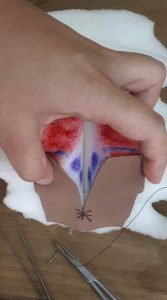 |
1. On the sponge block, glue a different fabric to simulate the skin; this helps differentiate the structures. In the model presented, the main muscle bundles were also drawn — the superficial transverse perineal muscle and the bulbospongiosus muscle.
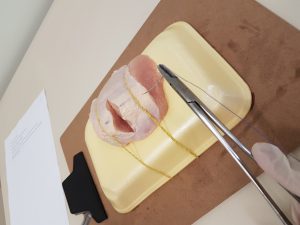 |
2. Many simulators are suggested using beef tongue. Another possibility is the use of chicken breast, preferably with skin. In the figure, it is adapted with simple elastic bands in the packaging in which it is sold.
Simulation
Instructions
1. In this short film, we are testing super glue (in this case, conventional contact adhesive) to simulate the use of surgical glue for perineal suturing.
WARNING: Do not use contact adhesive on human tissue!

https://forms.gle/oCYFdr8UbN1Gt4Bi8
|




